

How to Learn Backgammon Strategy Using Game Analysis

Most players try to get better at backgammon by playing more games. That helps, but it only gets you so far. If you keep making the same mistakes without understanding why, you can play thousands of games and still struggle with the same decisions.
Strong players take a different approach. They review the games they've already played, identify their mistakes, and study the concepts behind them.
Your own mistakes are some of the most valuable study material you have. They show you exactly where your understanding of the game breaks down, whether it's choosing the wrong checker play, doubling at the wrong time, or making a bad take decision.
Backgammon Cash's Game Analysis feature makes this process easier by grading every checker play and cube decision in a completed game, for both players.

Here's how to use those reports to build a repeatable study routine and start improving your game:
WHAT GAME ANALYSIS SHOWS YOU
Before getting into the review process, it helps to understand what you're looking at.
Game Analysis grades each decision based on how much equity you gave up compared to the best available play. Equity is the number of points you can expect to win from a position, on average.
Each decision receives one of four grades:
Correct: The best available play.
Almost correct: Within 0.02 equity of the best play.
Error: More than 0.02 equity worse than the best play.
Blunder: 0.08 equity or more worse than the best play.
The report separates checker plays, cube offers, and take/pass decisions. That distinction matters because each type of mistake requires a different approach to fixing it.
You can find a fuller explanation of equity, grades, and performance ratings on the Backgammon Cash Game Analysis page.
STEP 1: START WITH THE BLUNDERS
When you open a game report, resist the urge to study every move in order. Start by scanning the move list and flagging every blunder and error.
Blunders deserve your attention first because they often reveal a concept you don't fully understand yet. You might have made a move that looked reasonable at the time, but the engine found a much stronger alternative. The goal is to understand why.
For each blunder, ask yourself two questions:
What did I play?
What did the best play accomplish that mine didn't?
Maybe you left a checker exposed when you could have made an important point. Perhaps you missed an opportunity to build a prime, or you played too safely when an aggressive move offered a better long-term position.
Don't settle for memorizing the engine's move. You want to understand the reasoning well enough to recognize the same situation in a future game.
If you can't explain why the engine's move is better, get a second opinion. You have several options:
Use another analysis engine. You can recreate the position manually in an engine such as Backgammon Sage to explore alternative plays and understand why one is stronger than another.
Ask other players. The Backgammon Strategy & Puzzles Facebook Group and forums can be useful places to discuss difficult positions. Experienced players are often happy to explain their reasoning.
Ask for help from the Backgammon Cash team. If you're stuck on a position from a game, reach out and ask for an explanation.
Finally, write down the concept behind each mistake in a few words. For example, you might write "slotting versus splitting," "safe play versus bold play," or "timing in a prime-versus-prime."
These notes will become the foundation of your study plan.
STEP 2: LOOK FOR PATTERNS, THEN STUDY THE CONCEPT
One blunder is a data point. The same kind of blunder three times is a study topic.
After reviewing several games, go back through your notes. Are you repeatedly making the same kind of mistake? Maybe you're consistently choosing the safe play when a more aggressive move is better. Perhaps you struggle to recognize when to slot a point or when to break an existing structure.
These patterns tell you where to focus your study time.
Once you identify a recurring mistake, study the underlying concept directly. Find a relevant chapter in a backgammon book, read an article, or work through a lesson on that position type. Don't move on until you can explain why the correct play is right and when the same principle applies.
Then look for that concept in your next games.
For example, if you discover that you often make the wrong choice between slotting and splitting, pay particular attention to those decisions during your next few matches. When you review them, see whether your understanding has improved.
This is how you turn analysis into progress. You're not trying to memorize every position you've ever played. You're learning the principles that help you make better decisions across many different positions.
STEP 3: CHECK THE MOVES YOU WEREN'T SURE ABOUT
Your biggest mistakes aren't always the ones that surprise you. Sometimes, you have a feeling during a game that a decision is close, but you don't know which way to go.
Start paying attention to those moments.
When you're playing, make a mental note of decisions that give you trouble. Later, find them in the game report, even if they received a Correct or Almost correct grade.
If you made the right play, ask yourself whether you understood why it was right or simply got lucky. If you made the wrong play, add it to your study notes.
This is important because your instincts need to be calibrated. You want to learn which situations you understand well and which ones deserve more thought.
Over time, you'll become better at recognizing when a position is genuinely difficult for you. You'll also develop more confidence in decisions you understand, instead of second-guessing yourself unnecessarily.
STEP 4: FIX YOUR DOUBLING DECISIONS
Cube decisions deserve their own review session. A mistake with the doubling cube can cost more equity than a checker play mistake, and many players spend far less time studying cube strategy than checker play.
The first step is to sort your cube errors into three categories.
1. Missed doubles
You held the cube when you should have doubled. This often happens when you're too cautious or fail to recognize how strong your position has become.
2. Early doubles
You doubled before your position was strong enough. Your opponent could accept the cube without taking on enough risk, and you gave them a more favorable decision than necessary.
3. Late doubles, or losing your market
You waited too long to double. By the time you offered the cube, your opponent could correctly pass. You could have doubled earlier and continued playing for a better result instead of allowing them to pass out of the position.
Most players have a tendency toward one of these mistakes. Some are too cautious and miss doubles. Others double too early because they see a promising position and want to act immediately.
Find out which tendency affects you most before trying to fix everything at once.

Group your cube mistakes by position
Once you've sorted your errors into the three categories, look at the types of positions where they occur.
Races: When both sides are primarily trying to get their checkers home, pip counts and racing formulas such as the Keith count can help you evaluate cube decisions. This is a useful area to study because many racing decisions can be approached through calculation rather than intuition alone.
Attacking positions: Blitzes and positions where you're hitting opposing checkers can change quickly. Your advantage may grow rapidly, and you can lose your market if you wait too long to double.
Prime-versus-prime and holding games: These positions often depend heavily on timing. The number of checkers trapped behind a prime, the timing of each side, and the potential for the position to change all affect cube decisions.
Keep track of which position types produce the most errors for you. If you're consistently missing doubles in races, study racing cube decisions. If you're losing your market in attacking positions, focus on recognizing when your advantage has become strong enough to double.
Remember the rules of the game you're actually playing
There's an important detail for Backgammon Cash players: standard Cash Games don't count gammons. A gammon occurs when a player wins while their opponent has not borne off any checkers. In games where gammons count, the possibility of a gammon can have a major effect on cube decisions, particularly in attacking positions.
Without gammons, those decisions change. Players who learned cube strategy using general backgammon material may find themselves doubling too early if they don't account for the rules of their current game.
Backgammon Cash Game Analysis uses gammonless analysis for these games, so the grades reflect the rules you actually played under.
The maximum fee matters, too. Once the max fee has been reached, doubling isn't possible, and Game Analysis doesn't count an unavailable double as a mistake.
The best way to study cube decisions is to collect them across several games. Review your missed, early, and late doubles together, then group them by position type. You'll have a much clearer picture of your weaknesses than you would by looking at each decision in isolation.
STEP 5: FIX YOUR TAKE AND PASS DECISIONS
Take/pass decisions are another area where reviewing your mistakes can make a big difference.
Start with a simple question: Do you tend to take too often or pass too often?
Look at your recent game reports and count the errors in each direction. You might discover that you pass too readily when a position looks dangerous, or that you take doubles even when your winning chances are too low.
Fix your main tendency first. There's little value in studying subtle take/pass situations if you're consistently making the same basic mistake.
The basic rule
In a game where gammons don't count, taking is correct when you expect to win at least about one game in four.
The reasoning is straightforward. If you pass, you lose one point. If you take and lose, you lose two points, but if you win, you gain two points. Ignoring the additional value of owning the cube for a moment, you need to win about 25% of the time for taking to break even.
This is a useful starting point, but it's not the whole story.
When you take a double, you own the cube. That gives you the opportunity to double your opponent later if the position improves. Because of this extra value, some positions with winning chances slightly below 25% can still be correct takes.
That extra value disappears once the max fee has been reached and the cube can't go any higher. Game Analysis accounts for these rules when evaluating take/pass decisions if the cube is no longer in play on Backgammon Cash due to a MAX FEE being reached.
Watch for these two tendencies
Passing out of fear: You see a strong attack or an ugly-looking position and assume you're too far behind. But you may still have enough winning chances to justify taking.
Taking out of stubbornness: You don't want to give up, so you take even when your winning chances are too low. Sometimes the correct decision is to pass and accept the loss rather than take on a worse position.
The key is to stop judging these decisions by how the position looks or how the game eventually ends. Review the winning chances and the equity behind the decision instead.
STEP 6: SEPARATE SKILL FROM LUCK
One of the easiest ways to misjudge your progress is to focus too much on whether you won or lost.
You can play a strong game, make very few mistakes, and still lose because of the dice. You can also make several poor decisions and win anyway.
That's why Game Analysis includes a Luck rating alongside PR, or Performance Rating.
PR measures the quality of your decisions. Luck measures the effect of the dice. If you want to improve, judge yourself primarily on your decisions rather than the result of a single game.
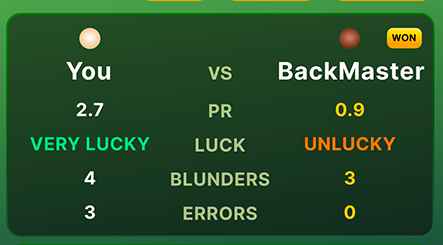
This is especially important when you're tempted to blame the dice for a loss. Instead of assuming you played well be cause you lost a close game, check the report. You may discover that you gave up substantial equity through avoidable mistakes. Or you may find that you played well and simply had an unlucky result.
The dice used in Backgammon Cash have also been reviewed by the World Backgammon Federation. You can read more about that process in our article on the WBGF dice review.
Separating luck from skill helps you review games honestly and focus on what you can control.
STEP 7: TRACK YOUR PR OVER TIME
PR, or Performance Rating, summarizes the quality of your decisions across a game. Lower is better because a lower rating means you gave up less equity through your plays.
It's tempting to judge yourself by the PR of your most recent game, but a single game doesn't tell you very much. The difficulty of the positions you face and the number of decisions in a game can affect your result.
Instead, watch your trend across many games. Are your average PRs gradually getting lower? Are you making fewer blunders? Have your cube decisions improved?
Those are better measures of progress than any single rating.
Don't worry too much about the label attached to your PR, either. The most important comparison is between your current play and your own play a few months ago.
A SIMPLE REVIEW ROUTINE
You don't need to spend hours analyzing every game. Start with a simple routine and repeat it consistently.
Flag all blunders and errors. Scan the report before studying individual moves.
Review the blunders first. Compare each one with the best play and write down the concept behind the mistake.
Check the moves you were unsure about. Confirm whether your reasoning was sound, even when the move was correct.
Sort cube errors. Label them as missed, early, or late doubles.
Count take/pass errors by direction. Identify whether you tend to take too often or pass too often.
Compare luck with PR. Don't let the result of the game determine how you judge your performance.
Look for recurring concepts. After several reviews, identify the mistake that keeps showing up and make it your next study topic.
When you're starting out, try reviewing every game. Once the routine feels natural, you can focus on the games that taught you the most, particularly those with difficult decisions or several significant errors.
The goal isn't to spend as much time as possible analyzing. It's to identify your biggest weaknesses and spend your study time fixing them.
~START LEARNING FROM YOUR OWN GAMES ON BACKGAMMON CASH~
The fastest way to make your study time useful is to focus on the mistakes you actually make. You don't need to master every backgammon concept at once. Find your biggest errors, understand why they happened, and work on the concepts that keep appearing.
Backgammon Cash Game Analysis is free for every Cash Game. A report for a Gold Game costs 500 Gold.
After your next game, open the report and start with your three most costly decisions. Figure out what you did wrong, write down the concepts you need to study, and look for those situations in your next games.
Repeat that process, and you'll have a much clearer path to improving your backgammon strategy.


Comments